What Buildings Remember: The Philosophy of Materials That Age With Dignity

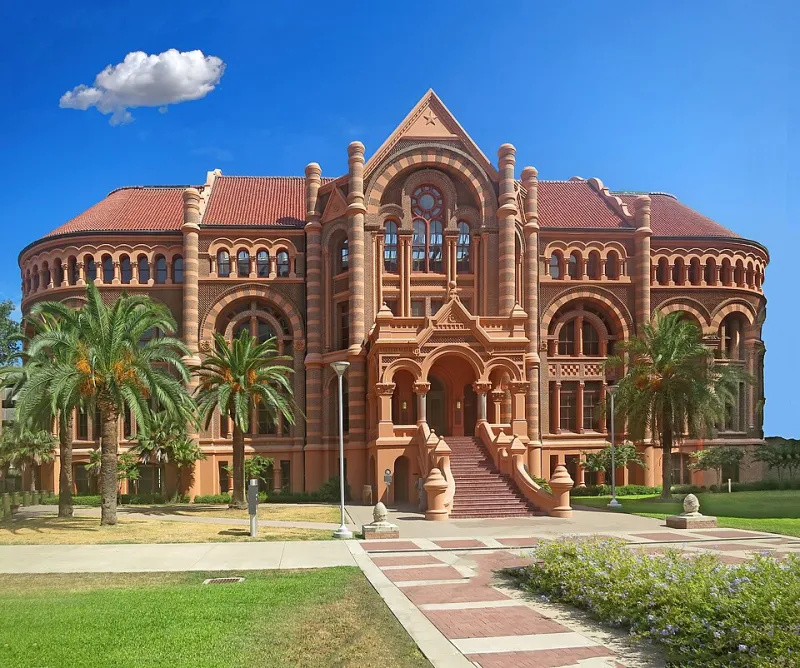
Photo: Gary Todd, CC0, via Wikimedia Commons
The Difference Between Aging and Deteriorating
There is a distinction that separates great architecture from merely competent construction, and it is rarely visible on the day a building opens its doors. It becomes apparent only over years—sometimes decades—as a structure begins to respond to its environment. Some buildings grow shabby. Others grow distinguished. The difference, more often than not, lies in the intentions of the architect who selected the materials.
At Ralph Duesing Architect, we regard material selection as one of the most consequential decisions in the design process. Not because materials define how a building looks when it is new, but because they determine how a building will speak to the people who inhabit and pass by it twenty, forty, and sixty years from now. This is what we mean when we speak of designing spaces that endure: we are designing not just for the present client, but for everyone who will encounter the building across its full lifespan.
Reading the Biography of a Facade
Every exterior surface is, in a sense, a record. Brick absorbs the particular humidity and dust of its region, deepening in color and developing subtle tonal variation that no factory process can replicate. A limestone facade in the American Midwest weathers differently than one in coastal New England—the freeze-thaw cycles, the mineral content of local rainfall, and the angle of prevailing winds all contribute to a surface biography that is entirely site-specific.
Copper is perhaps the most celebrated example of a material that improves through transformation. When a copper roof is installed, it carries a warm, burnished reddish-brown. Within a few years, it begins its long oxidation journey—moving through amber and brown before arriving, after a decade or more, at the pale verdigris that we associate with civic buildings, university halls, and houses of worship across the country. That patina is not decay. It is the material announcing its authenticity, its age, and its permanence.
Wood, when properly detailed and maintained, follows a similar trajectory. Douglas fir, cedar, and white oak each develop surface character through exposure to light and air. The silver-gray weathering of cedar siding on a New England farmhouse or a Pacific Northwest residence is not a sign of neglect—it is evidence of a material fulfilling its long-term potential. Architects who understand wood design for this transformation, detailing connections and overhangs that guide the weathering process rather than fighting it.
Thinking in Generational Timescales
The challenge for contemporary architecture is that much of the industry operates on timescales misaligned with the actual lifespan of buildings. Trend cycles in materials and finishes often run five to ten years. Buildings, by contrast, are expected to serve their communities for fifty to one hundred years or more. An architect who selects materials based on what photographs well in a current design publication may be inadvertently engineering obsolescence—creating a building that will look dated within a decade and require costly remediation within two.
Designing with generational timescales in mind requires a different kind of imagination. It asks the architect to envision not just the ribbon-cutting, but the building as it will appear to a child who grows up nearby and returns as an adult. It asks: will this facade have acquired presence, or will it have simply accumulated wear? Will these materials have developed the kind of surface richness that invites closer inspection, or will they have merely faded?
This is not an argument against contemporary materials or innovative construction techniques. Weathering steel, known commercially as Cor-Ten, was developed in the mid-twentieth century and has since demonstrated a remarkable capacity to develop a stable, protective rust patina that reads as both industrial and elemental. Glass, properly detailed and framed, weathers with quiet dignity. The question is not whether a material is traditional or modern—it is whether the architect has genuinely reckoned with how that material will perform across time.
The Economics of Material Honesty
There is a practical dimension to this philosophy that deserves direct acknowledgment. Materials that age well tend to require less intervention over a building's life. Brick facades that develop character do not need periodic repainting. Copper roofs that oxidize naturally require minimal maintenance once the patina stabilizes. Hardwood floors that develop a warm patina through use can be refinished rather than replaced.
By contrast, materials selected primarily for their initial visual impact—certain synthetic composites, painted surfaces over incompatible substrates, or cladding systems that trap moisture—often require significant remediation within the first twenty years of a building's life. The initial cost savings are real, but the lifecycle cost calculations tell a different story.
For commercial clients evaluating the return on an architectural investment, and for residential clients considering a home as a long-term asset, the material philosophy of the architect they engage has direct financial consequences. A building designed to age with dignity is a building designed to retain and accumulate value.
The Moral Dimension of Material Selection
Beyond economics, there is an ethical argument for choosing materials that endure. Buildings consume enormous quantities of embodied energy in their construction. When a structure is demolished prematurely—because its materials have failed, because it has grown visually exhausted, or because it no longer serves its community—that embodied energy is lost. Every ton of brick salvaged from a well-built nineteenth-century commercial building represents energy that need not be expended again. Every facade that requires replacement after thirty years represents a failure of architectural foresight.
At its most considered, material selection is an act of responsibility: to the client, to the community, and to the broader project of building a physical environment worth preserving. The architects whose work we most admire—from Henry Hobson Richardson's rusticated brownstone civic buildings to the weathered concrete of Paul Rudolph's later work—understood that materials are not merely surfaces. They are commitments.
Designing the Story Before It Is Written
When we begin a project at Ralph Duesing Architect, one of our early conversations concerns the arc of the building's life. We ask clients to consider not just how they want the building to feel on opening day, but how they want it to feel when their children encounter it. We look at the site's microclimate, its regional material traditions, and the specific ways in which sunlight, moisture, and temperature will act on every surface we specify.
This is what it means to design spaces that inspire and endure. Inspiration is not a static condition—it is something a building must continue to earn, year after year, as it becomes part of the fabric of a place. The materials we choose either support that ongoing process or undermine it. Chosen with care and foresight, they allow a building to do what only time can accomplish: to become, gradually and unmistakably, itself.