Ink Before Pixels: What the Sketchbook Knows That the Software Cannot
On the shelf behind my desk sits a row of sketchbooks going back more than two decades. Their spines are cracked, their corners soft with handling. Inside are courthouses in Missouri, lake houses in the Ozarks, a small commercial block in Kansas City that never got built. None of these drawings would win a rendering competition. All of them, I would argue, are more truthful than most of the images our industry produces today.
We are in the middle of a visual flood. Artificial intelligence can now generate a photorealistic exterior — complete with golden-hour light, mature landscaping, and a family silhouetted on the porch — in under a minute. Clients arrive at first meetings having seen hundreds of such images. It would be easy to conclude that the hand sketch, with its wobbly lines and smudged graphite, has become obsolete.
I believe the opposite. The rougher the tool, the more honest the conversation.
A Rendering Answers Questions; a Sketch Asks Them
The trouble with a photorealistic image is that it pretends to be a photograph of something that does not yet exist. It declares certainty where none is warranted. The moment a client sees a polished rendering, the conversation tends to shift from what should this building be? to can we adjust the color of the stone? The big questions get settled by accident, in the glow of a screen, before they've been genuinely considered.
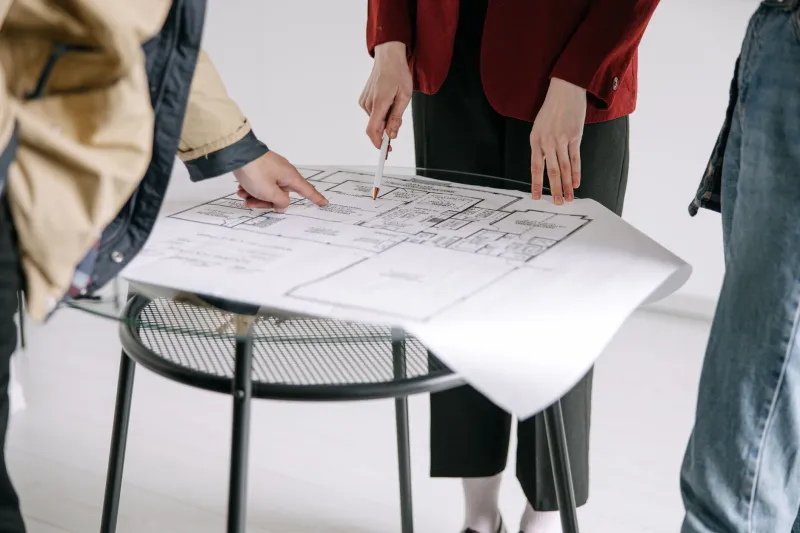
A sketch does the reverse. Because it is obviously provisional, it invites correction. When I draw in front of a client — on trace paper, on a napkin, on the back of a survey — they interrupt me. They pick up the pen themselves. The sketch becomes a shared object rather than a sales pitch. Some of the most important design decisions I've made in thirty years of practice came from a client grabbing the pencil and saying, what if the kitchen faced the other way?
Software, for all its power, rarely produces that moment.
What the Line Reveals
There is also a matter of intent. When an architect sketches by hand, every line is a decision made visible. The pressure of the stroke, the hesitation, the places where a form is drawn confidently and the places where it is not — all of it reveals how well the designer actually understands the problem. A machine-generated image conceals that. It is equally fluent whether the underlying idea is sound or hollow.
This is why I ask young architects in our office to sketch in front of clients and consultants, even when the final deliverables will be digital. Hand drawing is a form of thinking performed in public. It cannot fake understanding. If the massing doesn't work, the sketch shows it immediately — and that is precisely its value. Flaws caught on trace paper cost an eraser. Flaws caught in the field cost a change order.
The Building's Spirit Arrives Early
Every project has a spirit — a quality that is difficult to name and harder to render. It might be the way a porch holds the afternoon shade, or how a stair turns to catch a window at the landing. These qualities live in proportion and relationship, not in surface finishes. A sketch, stripped of texture and foliage and lens flare, is the fastest way to test whether that spirit exists at all.
If a design only looks good when rendered photorealistically, I have learned to be suspicious of it. The best buildings I've had the privilege of working on — a restored 1920s commercial front in St. Joseph, a compact ranch house renovation that suddenly breathes — all looked right as loose ink drawings before they looked right in any other medium.
Neither Nostalgia Nor Refusal
None of this is an argument against technology. We use BIM, we use digital visualization, and yes, we experiment with AI tools when they genuinely serve a project. Clients deserve to understand what they are building, and sophisticated imagery has a legitimate role late in the process, when the design has earned its confidence.
My objection is to sequence, not to software. When the first conversation with a client happens through a machine-generated image, the image does the thinking — and the thinking is not ours, and it is not theirs. When the first conversation happens over a sketchbook, the thinking belongs to everyone in the room.
The drafted line is slow, imperfect, and personal. Those are not its weaknesses. They are the reasons it still matters.