What Your Bookshelf Knows: Reading the Architecture of Everyday Life
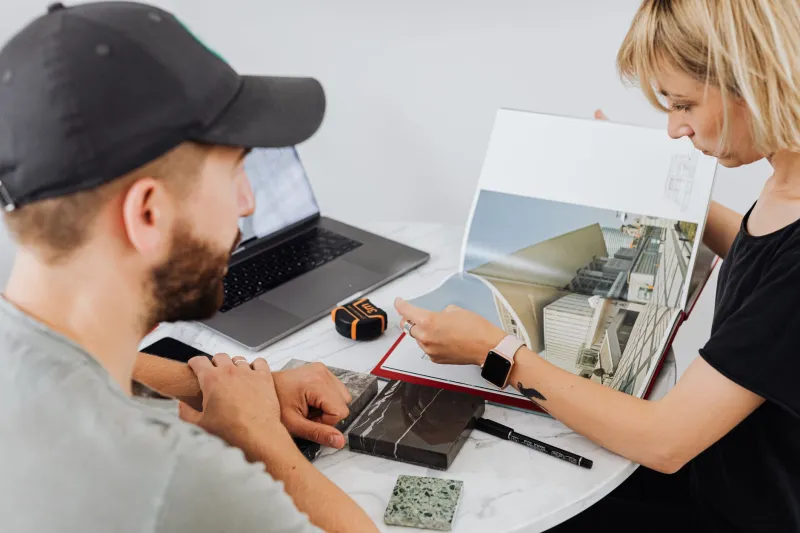
Early in every engagement, a client will hand us something meant to be helpful: a folder of saved images, a well-organized Pinterest board, a magazine spread with a corner folded down. We accept it graciously. And then we set it aside.
This is not because those images are without value. It is because they answer a question we have not asked yet. A mood board describes a feeling someone wants to have. Our job is to design a building that supports the life someone actually lives. Those are related goals, but they are not the same one, and conflating them is one of the most common sources of quiet disappointment in residential and commercial work alike.
The Gap Between the Life Imagined and the Life Led
A client's saved images almost always trend toward a certain kind of stillness: the sun-washed kitchen with nothing on the counters, the office with a single chair and a view, the living room arranged for conversation that never seems to include a television. These are portraits of an idealized Tuesday. But architecture is built for all 365 days, including the rushed ones, the messy ones, the ones when the household runs on a different logic entirely.
When we ask clients to describe their mornings and get back a description of their aspirations, we know we have more listening to do. The real information is usually delivered sideways — in what gets mentioned as an aside, an apology, a complaint about the current house that reveals something deeper about how the family actually moves through it.
Why We Ask About the Bookshelf
Over years of practice, we have developed a set of intake questions that seem, on the surface, to have little to do with architecture. We ask what is on the nightstand. We ask which room in the current home everyone gravitates toward and which one they avoid. We ask clients to photograph their daily routines — a simple audit of where things pile up, where light falls, where the day begins and stalls.
The bookshelf question is a favorite. What someone reads, and how those books are organized — alphabetized, stacked, crammed, or curated to a spine — tells us about how that person processes the world. Do they want order imposed from above, or do they thrive in productive clutter? Is the collection for display or for use? A person with two hundred cookbooks and a kitchen with eleven inches of counter space has told us something no rendering could.
None of this is psychological trickery. It is simply acknowledgment that people are not always reliable narrators of their own habits, and that a good architect's first task is careful observation before it is creative generation.
What the Photo Audit Reveals
The routine audit — asking clients to document a typical weekday in photographs — is often the most illuminating exercise we offer. Where does the mail accumulate? Where do the kids do homework, and is it where the parents think they do? In office work, we ask employees to photograph their actual workstations, not their assigned ones. The distance between those two photos is frequently the entire design brief.
We once worked with a couple who insisted their new home needed a formal dining room. Their image folder was full of them. The photo audit told a different story: every meal, every guest dinner, every holiday gathering happened around the kitchen island, with the formal room used for storage of seasonal decor. The design we ultimately built together honored the impulse behind the dining room — a sense of occasion, a place for gathering — without replicating the room itself. That solution was only available because we looked at evidence rather than aspiration.
Translating Aspiration Into Architecture
To be clear: the mood board is not a lie in the sense of dishonesty. It is a lie in the older sense — a partial truth standing in for a whole one. The client who saves images of minimalist interiors may not want minimalism at all; they may want relief from visual chaos, which could be achieved through better storage, better light, or better circulation rather than the removal of everything they own.
Our role is translation. The images become a vocabulary of feeling; the observations become a grammar of use. Good architecture requires both. A home that photographs beautifully but fails the household on a wet Tuesday morning in February is a failure, no matter how well it renders. A workplace that looks impressive in a portfolio but forces staff to walk four hundred extra feet to a printer is a failure of the same kind.
Designing From Evidence
What we have learned, and what we tell every new client at the first meeting, is this: the most valuable material you can bring us is not the folder of inspiration but the honest account of an ordinary day. Show us where you actually sit. Tell us what annoys you about the house you have. Let us see the bookshelf, the garage, the junk drawer.
The buildings that endure — the ones our clients still love a decade later — are not the ones that matched the mood board most faithfully. They are the ones that fit the lives inside them so well that the architecture becomes invisible, absorbed into the rhythm of daily use. That fit begins long before the first sketch, in the patient work of understanding who our clients really are, one photograph and one bookshelf at a time.