Rain Before Renderings: The Case for Falling in Love With a Site on Its Worst Day
There is a familiar sequence in American homebuilding: a client walks a lovely parcel on a crisp October morning, sunlight filtering through the oaks, a light breeze carrying the scent of leaves. The decision is made that afternoon. Sixteen months later, the family moves into a beautifully designed house and discovers that for half the year the site is a wind tunnel, that the spring thaw turns the side yard into a shallow lake, and that the glorious western sun they never thought to question turns the great room into a greenhouse every evening from June through September.
None of this is the builder's fault. The information was there all along—it simply required visiting the land on a bad day.
The October Afternoon Problem
Real estate in the United States is overwhelmingly shown under favorable conditions. Open houses happen on weekends when the light is flattering. Vacant land is toured when the ground is dry and the mosquitoes are dormant. This creates what we might call the October Afternoon Problem: a systematic bias in which buyers make one of the largest financial commitments of their lives based on perhaps the ten most pleasant days of the local year.
A house, however, is inhabited across every season and nearly every hour. It endures the March sleet in Minnesota, the August humidity in the Carolinas, the Santa Ana winds in California. A site that charms on a mild Sunday can be punishing in February. The only way to know is to show up when it is inconvenient.
What to Look For When the Sky Turns Gray
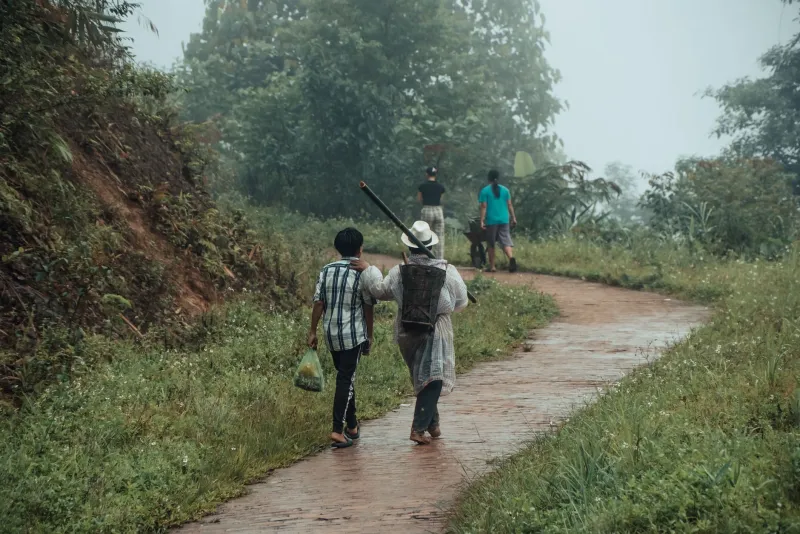
We advise clients to schedule at least one visit during or immediately after a significant rain event, and another on a hot, still summer day. Bring boots and an umbrella, and treat the visit as a working observation rather than a stroll.
Follow the water. Rain reveals a site's drainage character faster than any survey. Where does water collect? Does it sheet across the building area, pool in low spots, or carve channels along the slope? Standing water that lingers more than a day suggests poorly draining soils; water rushing downhill toward your intended homesite is a design problem you will pay to solve later, one way or another.
Stand still and listen. A site's acoustic profile changes with weather. Wind funneled through a valley, traffic noise from a highway that becomes audible when leaves drop, the neighbor's dog two hundred feet away on a still winter morning—these are the ambient conditions your daily life will actually contain.
Check the wind, not just the view. Exposed hilltops and open fields offer sweeping vistas and relentless wind loads. Note the direction of prevailing winds and consider what sheltering vegetation or topography exists. A well-oriented house can harvest a summer breeze; a poorly sited one will fight a winter gale for thirty years.
Look at your neighbors, and let them look at you. Deciduous trees conceal sightlines beautifully in July and expose everything in January. If you can, visit in the dormant season and imagine the views—both yours and theirs—in every month.
Track the light honestly. A gray afternoon tells you something a sunny one cannot: how much ambient light the site receives when the sun is absent. In much of the northern United States, homes will live under overcast skies for months. A site shaded by dense evergreens to the south may feel dim and cold indoors no matter how generous the windows.
From Observation to Brief
These observations are not merely due diligence; they are raw material for the design itself. At our practice, a bad-weather site walk routinely reshapes the architectural brief in productive ways.
Water that crosses the site might suggest raising the primary level, orienting the garage as a buffer, or designing a rain garden that turns a liability into a landscape feature. Relentless western sun might rotate the plan, deepen the porch overhangs, or position the screened porch where the family actually wanted the deck. Winter wind might argue for a compact, courtyard-facing massing rather than a spread-out footprint with exposed glass on three sides.
In other words, the site's flaws—properly witnessed—are often its best design instructions. A house that responds to real conditions rather than a fair-weather memory will be more comfortable, more durable, and frequently less expensive to operate than one that ignores them.
A Modest Protocol
If you are evaluating land, we suggest this simple discipline before making an offer:
- Visit during or just after a heavy rain, and photograph every place water moves or pools.
- Visit on the hottest, stillest day you can manage, and note heat, glare, and insect pressure.
- Visit on a gray, late-afternoon winter day to assess ambient light and sightlines.
- Bring your architect, or at minimum a notebook and a compass app.
None of these visits costs more than an afternoon. Compare that to the cost of relocating a driveway, installing drainage you did not plan for, or living for a decade with a living room that is unusable after two in the afternoon.
Buildings are patient. Sites are honest. The rain, the wind, and the February gloom will tell you the truth about a property long before the closing table does. Listen to them, and the house you eventually design will be the better for it—on every one of the three hundred sixty-five days a year you will actually live there.